Wednesday, October 29, 2008

The Ministry of Education Praises Goods for Good's Efforts - Aaron Lewani

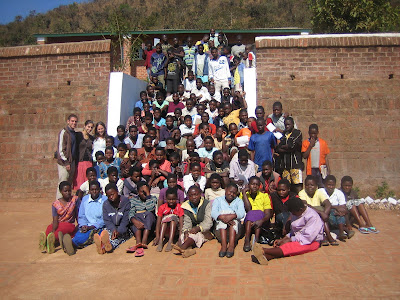
One bright Saturday morning in August, I joined Mr. Kalanda, the Director of Primary Basic Education from the government’s Ministry of Education, in visiting public primary schools in Malawi. Mr. Kalanda had asked to tour Goods for Good’s projects at schools in Malawi after working with us for some time on our project at Tiyambe Nawo. Brian Mlenga from Africare, our program partner, also accompanied us. After a fascinating drive in which we discussed everything from marriage to the US elections, we finally arrived at Msamba Adzukulu Primary School in Dowa district where the Head teacher, the School Committee Members, and Group Village Headmen warmly welcomed us.

At Msamba Adzukulu, Mr. Kalanda first had a meeting with the School Teachers, Local Leaders and School Committee Members. During the meeting, the Head Teacher, Mr. Phiri, made a summary presentation of what Goods for Good and Africare are doing at the school. He spoke glowingly about how Africare is supporting the school with sanitary facilities while Goods for Good is supporting them with pens and paper to the students. He highlighted the Teacher Supplies Closet program, which provided flipcharts, markers, lesson planning pads and pens to the teachers. “This support has tremendously improved our work, which has resulted in increased school attendance and enrollment. We are now enjoying our work more, since we have the materials to use when working,” said Mr. Phiri.

The Group Village Headman also gave a short speech, in which he said: “Goods for Good has done a commendable job. As parents, we stopped worrying for pens. Children are much more interested in school than before because they have necessary writing materials. This has boosted their morale in school.” He emphasized that the problems, unfortunately, are still many, and he asked the Ministry of Education if it could support them with iron sheets to roof an empty and unusable school block.

After the community members presented, Mr. Kalanda had an opportunity to speak. He said, “Today, I am very impressed with what I have heard and seen for myself. As government, the funding that we receive from our national budget is too small to reach over 5,000 primary schools in the country. When we encounter organizations like Goods for Good and Africare, we really appreciate their work very much.” He went on to say that donating two pens per term to each student in 13 schools makes a big difference and saves the communities a lot of money. He also commended the Teacher Supply Closet program, noting it is very helpful since the teachers need many resources to plan and teach the children. He commended the c
ommunity for taking part in the development of their own village, and advised them to pursue Members of Parliament for constituent funds for the iron sheets.

On his part, he pledged to send more teachers to the school. He said that immediately after that meeting he would convene meetings with the District Education Managers to discuss problems that the primary schools are facing in the districts. He noted that the problems at Msamba Adzukulu Primary School would be used as an example during those meetings. “Our ministry has a lot of work to do which we cannot accomplish on our own. The help we receive from partners like Goods for Good matters most,” he said in conclusion.

Friday, October 17, 2008

VOLUNTEER IN MALAWI

HI FROM THE GOODS4GOOD TEAM!

You can now VOLUNTEER IN MALAWI with Goods4Good! We've launched a volunteer program to send students, teachers, social workers, lawyers, managers and other people with relevant experience and skills to Malawi to help in a variety of programs at our partner organizations.


In December, we'd like to send 4-6 volunteers for 2-3 weeks to work with teachers on classroom skills in under-resourced schools and orphan care centers. This is a great opportunity for college students on break, teachers on vacation, and anyone looking to do something valuable in a short amount of time and travel abroad while doing it!

Read below for more information and PLEASE send this to anyone you think might be interested - We'd like to finalize participants in the next month, so don't delay!

Please contact us at info@goods4good.org if you have questions.

Thank You!

Brigitte, Ilana and the rest of the Goods for Good team....

Teacher Methods Training

Spend two to three weeks volunteering in Malawi, running a teacher training course for nursery school and primary school teachers. The program will consist of leading workshops for teachers as well as modeling new techniques in the classroom. The overall goal of this program is to teach teachers more effective but culturally appropriate teaching techniques such as classroom management, participatory learning, etc. Volunteers will have the unique opportunity to compile and execute a curriculum of critical teaching techniques. Housing will be available at St. Mary's Rehabilitation Center, an orphanage run by Spanish nuns with first world amenities, which is where the nursery school is located. The elementary school is a five minute walk from the center. In addition, volunteers will spend five days living and volunteering at Tiyambe Nawo, a community based organization in Nkangamira, where volunteers will provide the same teacher training to the nursery school staff there. Additionally, G4G will arrange a tour of our programs and a weekend retreat.

G4G will not be offering funding for volunteers, although housing will be free of charge and basic food will be provided by St. Mary's and Tiyambe Nawo. The largest cost associated with this trip is airfare, which will be around $2,500. Volunteers should budget an additional $500 for incidental expenses associated with travel and staying in Malawi.

Degree in or experience with teaching preferred.

Thursday, September 4, 2008

Not Your Regular Party - Yehuda Gruenberg

Last week I had the pleasure of volunteering at the G4G warehouse in New Jersey. It was a fantastic day -- hot outside but nice and cool in the basement where we were working. We started out unpacking boxes upon boxes of surplus pharmaceutical pens in order to count, sort, and package them for shipment to Malawi. What struck me almost immediately was the amount of waste we barely even begin to contemplate in our everyday lives -- if we were not sending these school supplies to children in Malawi, they would probably end up in the garbage. That is what is so simple and yet so wonderful about the work of Goods for Good; taking unused goods and putting them to good use.

As I helped the G4G team go through tens of thousands of pens, I started thinking about the pictures I have seen from Goods for Goods' numerous trips to Africa. I could not help but wonder what these pens, or more aptly what their owners, would someday create. Ten thousand pens, ten thousand children -- the creative and intellectual possibilities are endless -- it just felt good knowing that my hands participated in that creativity, somewhere, in some small way. I kept picturing the smiling faces of the children as they receive their school supplies, the bright optimism that adults experience when they see their children well-equipped and ready to learn. I only wish I could be there on the other end of the line to help unpack these boxes I just packed, and see the faces firsthand.

My fellow volunteers were outstanding. People from all walks of life, helping not because it is 'a mitzvah', not because it is the 'christian thing to do', but because it is the right thing to do. From the G4G staff (Mel, Jeremy, and Brigitte), to Jeremy's friends Jay and Leslie, to the high schoolers who gave up a summer sunday to be there, to Joe's family, we worked hard but we all seemed happy knowing that the fruits of our labor were truly appreciated by people we would likely never have the chance to meet.

I feel very fortunate knowing that there are organizations like G4G in this world,who see something that needs fixing and who do it because it needs to get done. I hope that I can be involved in many packing parties yet to come and I encourage anyone who comes across this blog to get up, get active and get involved. Change starts with one person, one sunday afternoon, one selfless act. Thanks to G4G for giving me the opportunity to be part of it.

Volunteering In Malawi, Totally Different than Canada - Michael Fresco

I’d never really been out of the country before this year. Ok, I’ve been to Canada and Mexico on family trips, but I’d never left North America, never been some place really different. That changed as January 2008 saw me to Italy for school, and when I came home in May I received an e-mail from my cousin Melissa. It was a forwarded message but the introduction was personalized, and it read: “I heard you might be looking to get out of the country again…”
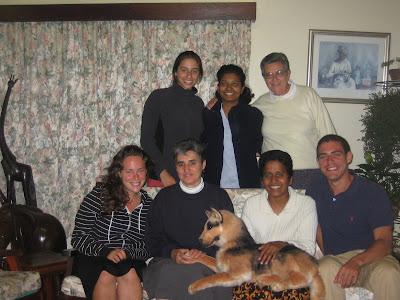
So that’s how my trip to Malawi began. On July 30th I and my two fellow travelers, Talia and Ilana, set out for ‘The Warm Heart of Africa’, and after 36 hours and three flight transfers we arrived, a bit delirious but happy nonetheless.

Our first taste of Malawi came with the drive from the Airport to St. Mary’s. The landscape of Malawi is beautiful, and in that travel-weary state it reminded me of Italy – big, rolling foothills, wide open valleys, spectacular views – only the colors were different. Everything was a dried out brown instead of lush green (I later learned that during the rainy season, this is not the case).

And if the landscape was beautiful, the roadside scenery was striking. Downtrodden storefronts with no windows, small clusters of straw-roofed shacks with no doors, children walking the street barefoot and shirtless. The poverty was evident and everywhere, and I think all three of us were nervously waiting to see where the car would stop.

When we arrived at St. Mary’s (which, if you don’t know, is an orphanage and rehabilitation center where Melissa and Jeremy lived and through which Goods for Good often sponsors distributions) I was surprised and delighted. It’s a beautiful campus, green with nice buildings, windows and all. It reminded me of summer camp, really; there was a directors’ house, boys and girls’ bunks, a rec hall, mess hall, staff quarters and a soccer field. We were made to feel even more at home by Sister Rosemary, who picked us up from the airport and was at once kind and accommodating. All the Sisters were. We ate dinner at their house that night. It was delicious.

Above I described the poverty that faced us everywhere outside the walls of St. Mary’s.I should elaborate by saying that the people of this country, their personalities and outlook, are in no way indicative of their surroundings. As time passed and we met several Malawians, at school, around Chezi (the town we were living in) and in travel. We were all amazed at how friendly, earnest and eager to talk they were. Nowhere did we meet a Malawian who seemed bitter or resentful, despite the conditions all around them.

This attitude was most obviously embodied by the children we got to know at St. Mary’s, as well as those who came to school at St. Matthias from surrounding villages. Here were kids who had in some cases lost everything (their parents), and were still generally cheery and fun loving.
And smart! Once we started teaching we were surprised again – this time by how well behaved and eager to learn the kids were. They gave us their full attention, didn’t talk in class, and were just wholly better than any American middle school class I’d ever seen.

Not only were they attentive, but most of them had a surprisingly firm grasp on the subjects covered in class. Malawi’s primary school system, its classes and exams, are all done in English, a second language (at best) to each student. I taught science, and was worried about all the specific terminology it would involve, but the students successfully navigated tough concepts like electricity, air pressure and properties of sound waves. Surprising.

Still, the issue of English-language classes in areas like science, math and social studies puzzles me. In a country where children are struggling to stay focused and even to attend school, the language issue presents another significant challenge to those trying to better their station in life. And while the better students typically speak functional English, a lot of the slower kids don’t. For all I know they might not be slower at all, because as I moved to individual help it became clear that for some children not knowing the answer wasn’t the problem; they didn’t understand the question. This was and is a challenge I have to applaud these kids for rising to.

Congratulations are also due to the staff of St. Matthias primary school. Mr. Banda, the headmaster, was very welcoming to us and is clearly respected by his students and coworkers. The other teachers we came to know are good people, and all share an admirable commitment to their work. They do a great job and St. Matthias is consistently one of the top schools in the country. Still, the lack of simple learning tools is immediately apparent, and I found myself distributing notebook paper and pens from my backpack on a daily basis, so much that I ran out. The kids couldn’t even take notes. This illuminated for me the importance and necessity of the type of work being done by Goods for Good and other organizations.

On that topic: there was one Sunday when Aaron, a Malawian employee of Goods for Good, took us on a drive through the country to visit some of the other projects the organization is involved with. We went first to the organizational center of Consol Homes, a Malawi-based aid organization. The structure, partially sponsored by Goods for Good, houses certification in carpentry and tailoring for older students as well as after school care for younger ones. We also visited a small village home to the founders of Tiyambe Nawo (another Malawian NGO), Mr. and Mrs. Benis. They invited us to lunch in their home (nsima, nsima, nsima) and later we visited the newly constructed community center/nursery schoolhouse, a project funded by Goods for Good. Mr. Benis pointed out to us the community’s former schoolhouse; it was a small shack caught in the middle of collapse, one you or I would probably take for an old tool shed. When we saw the Goods for Good label on the brand new building – and I believe I can speak for my partners here – we felt a great deal of pride to be representatives of such a cause.

Now that I’m back, people often ask what will I miss most about Malawi. Here is the answer: having a position of modest importance in the lives of the children of St. Mary’s and St. Matthias. They all became good friends, and I like to think they enjoyed having us around.

I owe a huge thank you to Goods for Good who gave me the opportunity to go to Africa. Thanks also to the staff of St. Mary’s – Sisters Victoria, Parfalia, Sheba, Shinee and Rosemary, and John Mwanza, as well as the staff of St. Matthias, Mr. Banda, Mr. Nkhota, the other Mr. Banda and all the rest of the teachers there. Lastly, thank you to Talia Kraemer and Ilana Kahn for being great friends, teachers, and roommates. And chefs.

104 Big Smiles!

One day this past July, I visited Tiyambe Nawo Community Based Organization, where they were distributing clothing, provided by Goods for Good to children from their three child care centers: Tiyambe Nawo; Nsangu; and Mphanda. When we arrived at the center, the children welcomed us joyfully, and Tiyambe Nawo volunteers went ahead with the clothing distribution.

As the children began receiving their clothing, every one of them was coming out of the distribution room with big smiles. Looking at them, no one could miss the joy and excitement that these children had. I managed to meet few of them to hear why they felt such glee.

Major Maunda was the first child I chatted with. He said he would like to be a medical doctor after completing his education and likes playing football in his free time. Major explained, “I am very happy with these beautiful clothes I have just received. I will be putting them on when going to school, to wedding ceremonies, and to church. Without this I would have been wearing my old clothing, which is in a bad state.” Major, who stays with his mother, lost his father a couple of years ago. He was so thankful to those who gave the clothing and sent his greetings to them.

As the distributions continued, I met a young girl who was in a very jovial mood; her name is “Zione,” which means “watch that” in Chichewa. Zione likes playing netball and her favorite food dish is rice with meat. When I asked Zione about her new clothing she exlaimed “I am so excited to receive the clothing because I have found something to wear. My mom faces difficulties in buying me clothing so this is my greatest opportunity. Now I have clothing to wear at home and at school.” Twelve-year old Zione said she would work hard to reach her dream of becoming a nurse.

Lastly, I met Mr. Moses Chinzimu, a man in his late thirties. He told me: “I have received clothing for Mphatso, Suzen, and Hadwick: these are my young brother’s children. They could not come here because they went away to see a relative at a distant place. My brother died a year ago and left these three children, who are staying with their grandmother. The clothing will make the children look beautiful and dignified. I am so grateful to the people who are concerned with the needs of these children and provide support to them. It is very difficult for their guardians to get money to buy them food, let alone clothing.”

Indeed, the clothing brought much joy to the 104 children who received the clothing on this particular day!

A Simple, but Transformative Moment

Daniel Nsonthi is a 14 year old boy whose mom died when he was five years old. Despite losing a parent at such a tender age, Daniel has continued to work hard at one of the reputable government high schools in Malawi, where he is a form one (9th grade) student. Unfortunately, because of a simple lack of school uniform, his education was hindered until Goods for Good distributed school uniforms last April.

In April 2008, I participated in the uniform school distribution at Consol Homes. Consol Homes is implementing this program in partnership with Good for Good. Goods for Good provides the fabric for making the school uniforms while Consol Homes uses their students enrolled in a tailoring vocational training – usually orphans who dropped out of school – to sew the uniforms. This partnership teaches a marketable skill to orphans without other options, and provides free school uniforms to those orphans still enrolled in the school system.

I was fascinated by the huge numbers of boys and girls who turned up to receive the school uniforms on this particular day. Many of them walked on dirt roads without shoes for over ten miles to get to the distribution. Then they waited several hours in the hot sun to see if they would be one of the lucky ones to receive a uniform. It made me feel both sad and inspired that they were willing to go through so much for something as simple as a school uniform – an item that many children across the world disdain and take for granted.

Of course, children wouldn’t be lining up in the hot sun if uniforms weren’t critical to success in the Malawian education system. School uniforms are required by law in Malawi, a policy that excludes many impoverished children from obtaining an education. In particular, orphans attending school in Malawi find it challenging to save the money, about three dollars, for a school uniform. Although cheap by US standards, they cost a lot for a low-income family in a developing country. Most caregivers cannot afford them, especially when they are caring for many children as the result of AIDS-related deaths in their community. Unfortunately, many children obtain a uniform only by missing school to work odd jobs, saving up for their uniform and other required school materials bit by bit.


On that sweltering April day, Consol Homes distributed 700 uniforms to students in primary and secondary school in rural Malawi. The need is so great that many more than 700 children showed the day of the distribution, but there was only enough for 700 children. It was during the distribution that I met Daniel, one of the fortunate children to receive a uniform. He told me that he was very happy to receive the school uniform because he had been told by his teachers that those students who would come without school uniform when school opens for the second term would be sent back immediately without any negotiation. Daniel had been kicked out of school for failing to wear a uniform last term, and he confessed that the teachers’ announcement worried him very much. He told me that sometimes he borrows a school uniform from a friend to attend classes.

Two weeks after the uniform distribution, I made a visit at Dzenza secondary school to see what a difference the school uniform was making in Daniel’s life. He told me that the uniform he received had allowed him to start the school term with joy. He was able to attend every class, which had resulted in immediately improved grades: He had performed very well with an average passing mark of 75%, the level of “distinction” in Malawi. Daniel has truly turned around his educational path, and the impetus was the school uniform. As I continue in my employment with Goods for Good, I look forward to being a part of many more simple, but transformative moments.